Neural Decompilation
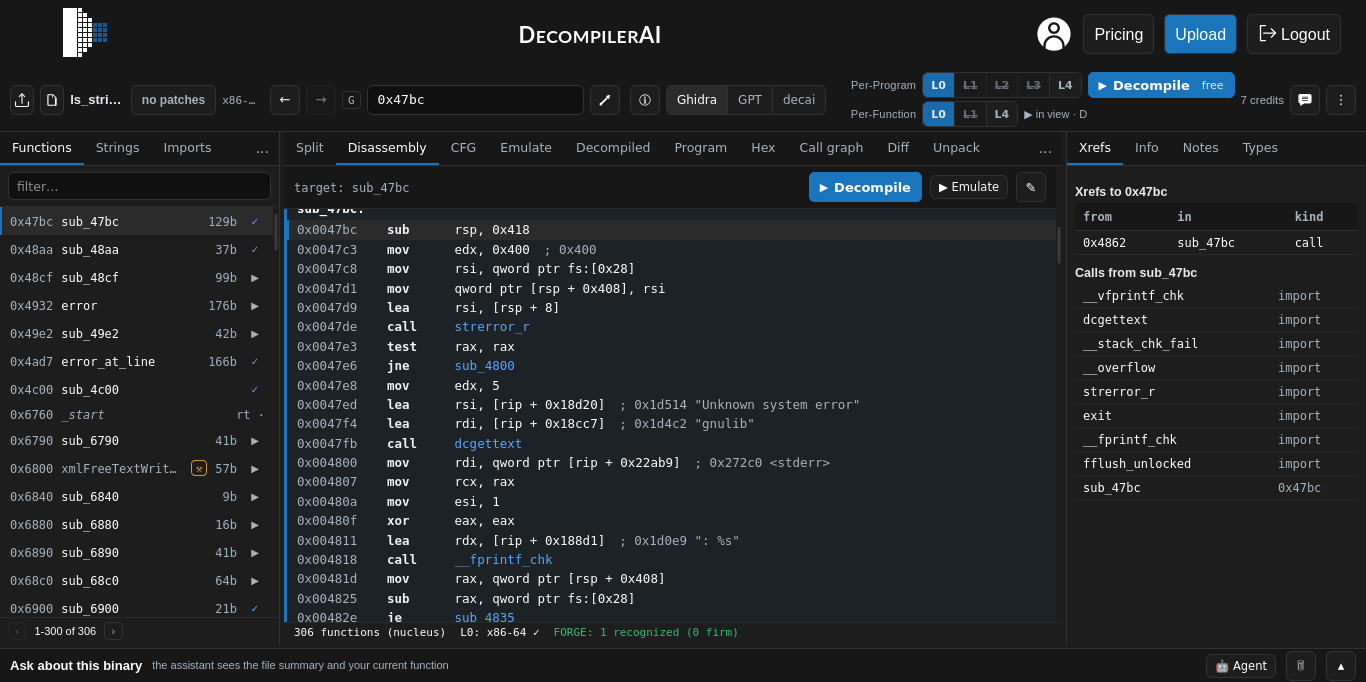
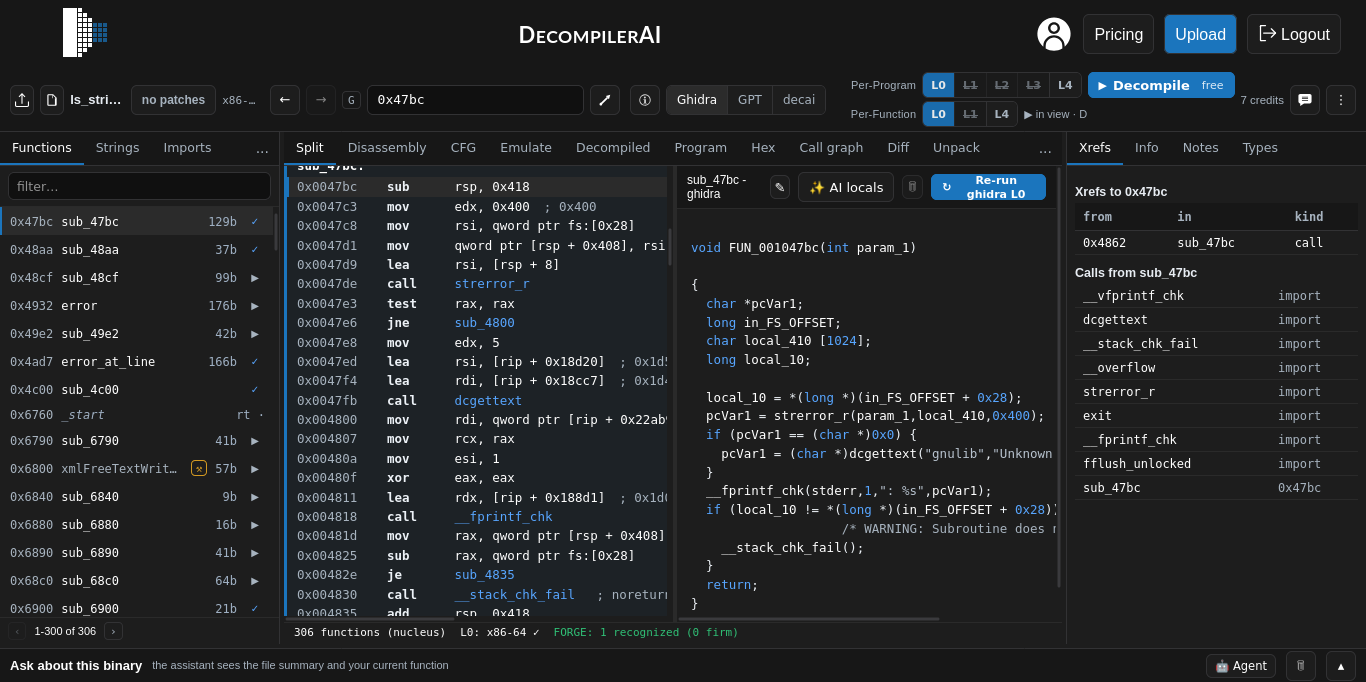
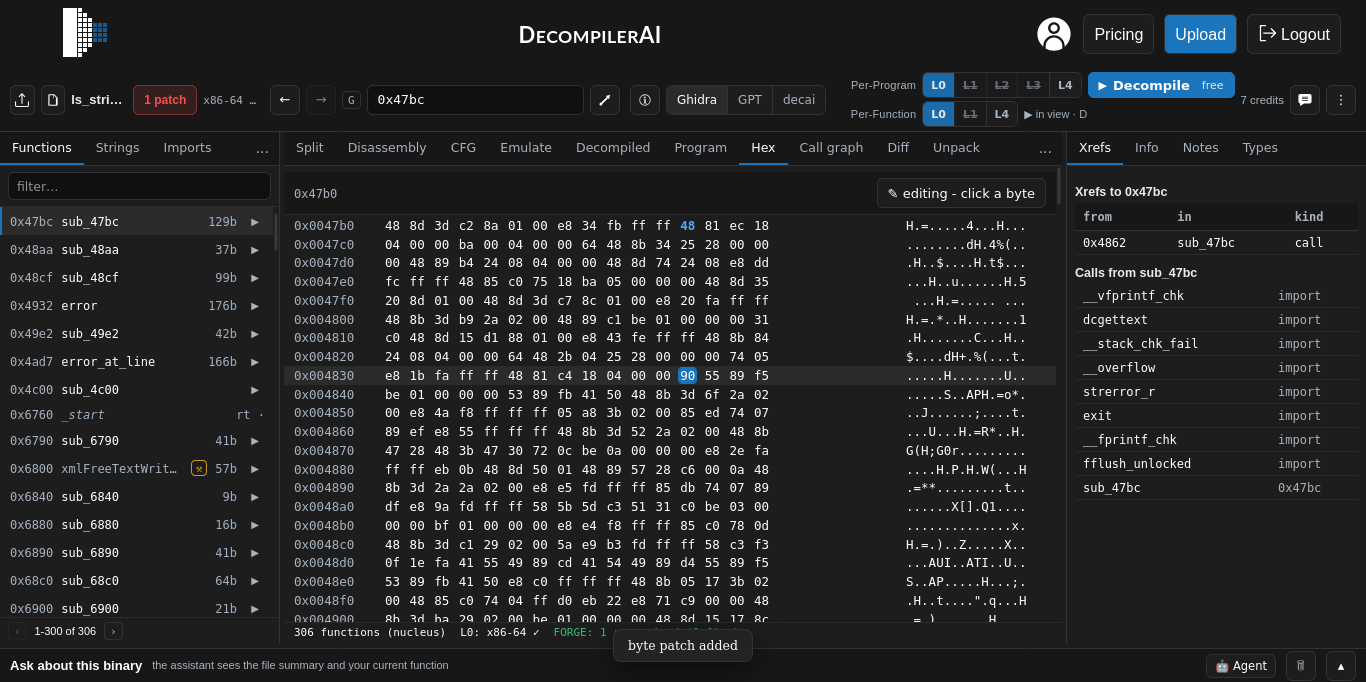
We leverage custom trained AI models to yield explainable high-level C code, currently for non-obfuscated ELF (x86-64, AArch64) and PE (x86-64) programs compiled with GCC or Clang.
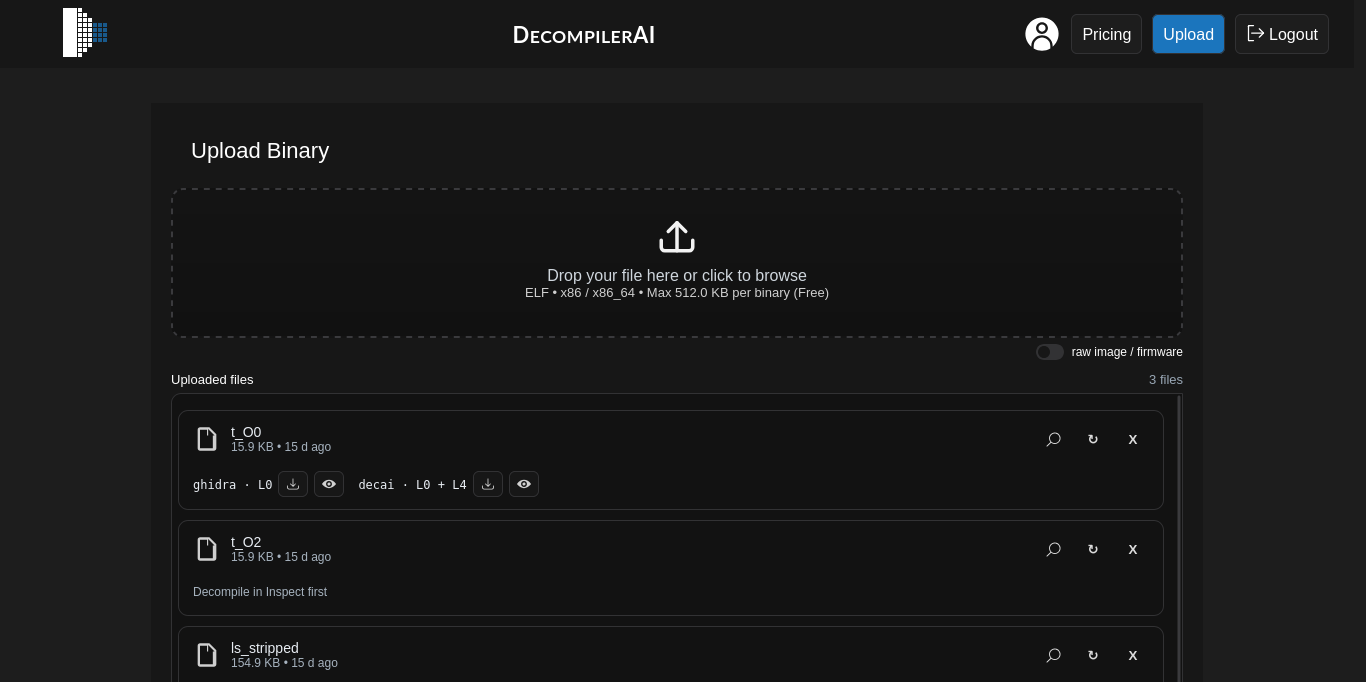
Upload a binary executable file, get readable, compilable and functional equivalent C code. No setup, just results.
// Decompiled with DecompilerAI
#include <stdio.h>

int findMSBPosition(int a) {
    int i, k = 0;
    if (a == 0)
        return -1;
    for (i = 0; i < 32; i++) {
        if ((a >> i) & 1) { k = i; }
    }
    return k;
}

int main() {
    int a = 37;
    printf("MSB position of %d: %d\n", a, findMSBPosition(a));
    return 0;
}
// Target
#include <stdio.h>

int findMSBPosition(int num) {
    if (num == 0) return -1;
    int position = -1;
    for (int i = 0; i < sizeof(int) * 8; i++) {
        if (num & (1 << i))
            position = i;
    }
    return position;
}

int main() {
    int num = 37;
    printf("MSB position of %d: %d\n", num, findMSBPosition(num));
    return 0;
}
We leverage custom trained AI models to yield explainable high-level C code, currently for non-obfuscated ELF (x86-64, AArch64) and PE (x86-64) programs compiled with GCC or Clang.
We leverage various tools like traditional decompilers and LLMs (DeepSeek, OpenAI, ...) to yield explainable clean code.
We target to deliver readable source code. Appropiate function/variable names, types, and comments help users understand the high-level source code in a faster fashion.
Unlike traditional decompilers (e.g. Ghidra, IDA Pro HexRays Decompiler, ...) that yield pseudocode, we target to deliver compilable source code. We deliver the source code along instructions to build the program from scratch.
We target to deliver source code that is functionally correct. The input and output behaviour of the target and decompiled program should be identical.
Drag-and-drop binary executable files and request decompilation right away. ELF, PE, Mach-O and Android APK / XAPK / DEX.
| Benchmark | .c/.h | SLOC/fn | CC | CG depth | FI/FO | LC |
|---|---|---|---|---|---|---|
| HumanEval | 164 | 39.93 | 3.44 | 1.00 | 0.88 | 0.73 |
| ExeBench | 222 | 25.39 | 1.72 | 0.25 | 0.20 | 0.86 |
| Random GitHub | 1776 | 2312.29 | 37.85 | 2.06 | 1.29 | - |
| Coreutils | 1680 | 132.47 | 8.34 | 9.93 | 2.04 | 0.75 |
| OpenSSL | 1795 | 251.17 | 6.06 | 31.49 | 2.79 | 0.66 |
| FFmpeg | 4336 | 284.98 | 7.29 | 18.39 | 2.54 | 0.09 |
SLOC/fn = source lines of code per function, CC = cyclomatic complexity, CG depth = average call-graph depth, FI/FO = average fan-in/fan-out, LC = GCOV line coverage.
| Decompiler | Benchmark | Metric | Baseline Test Suite | DecEvalSe | ||||||||
|---|---|---|---|---|---|---|---|---|---|---|---|---|
| O0 | O1 | O2 | O3 | AVG | O0 | O1 | O2 | O3 | AVG | |||
| Ghidra+ LLM4Decompile |
HumanEval | Compilation Rate | 0.87 | 0.80 | 0.85 | 0.81 | 0.83 | 0.87 | 0.81 | 0.84 | 0.81 | 0.84 |
| Pass Rate | 0.69 | 0.46 | 0.47 | 0.46 | 0.52 | 0.67 | 0.41 | 0.42 | 0.40 | 0.48 | ||
| GCOV | 0.73 | 0.68 | 0.66 | 0.55 | 0.66 | 0.86 | 0.81 | 0.80 | 0.82 | 0.82 | ||
| ExeBench | Compilation Rate | 0.63 | 0.42 | 0.42 | 0.42 | 0.47 | 0.63 | 0.42 | 0.42 | 0.42 | 0.47 | |
| Pass Rate | 0.44 | 0.29 | 0.29 | 0.28 | 0.33 | 0.41 | 0.28 | 0.28 | 0.27 | 0.31 | ||
| GCOV | 0.86 | 0.87 | 0.85 | 0.88 | 0.87 | 0.90 | 0.89 | 0.89 | 0.89 | 0.89 | ||
HumanEval ratios are computed over 116 functions. ExeBench ratios are computed over 500 functions. The baseline consists of handwritten tests for HumanEval and randomized DecEvalRand tests for ExeBench.
| Decompiler | Repository | Comp. Rate | Pass Rate | KLEE-IC | GCOV-LC | Time [h] |
|---|---|---|---|---|---|---|
| Ghidra+ LLM4Decompile |
HumanEval | 0.87 | 0.67 | 0.33 | 0.86 | 0.3 |
| Coreutils | 0.71 | 0.67 | 0.27 | 0.75 | 2.7 | |
| OpenSSL | 0.48 | 0.25 | 0.36 | 0.86 | 2.5 | |
| FFmpeg | 0.61 | 0.45 | 0.29 | 0.90 | 6.4 | |
| Ghidra+ SK2Decompile |
HumanEval | 0.88 | 0.76 | 0.33 | 0.85 | 1.1 |
| Coreutils | 0.50 | 0.46 | 0.28 | 0.72 | 3.2 | |
| OpenSSL | 0.40 | 0.21 | 0.33 | 0.78 | 3.0 | |
| FFmpeg | 0.55 | 0.42 | 0.29 | 0.89 | 9.8 | |
| Ghidra+ Idioms |
HumanEval | 0.76 | 0.65 | 0.33 | 0.86 | 1.2 |
| Coreutils | 0.46 | 0.45 | 0.32 | 0.91 | 3.6 | |
| OpenSSL | 0.38 | 0.19 | 0.28 | 0.75 | 3.4 | |
| FFmpeg | 0.44 | 0.35 | 0.27 | 0.93 | 10.0 |
For the complex-repository setup, the paper evaluates Coreutils 9.7, OpenSSL 3.0.15, and FFmpeg 7.1.3, with up to 500 functions per executable.
Exact decompiler configurations used for the evaluation: LLM4Decompile with the Ghidra-refined approach and the LLM4Decompile-Ref-6.7B checkpoint; SK2Decompile with the sk2decompile-struct-6.7b and sk2decompile-ident-6.7b checkpoints; Idioms with the opt-O0-codegemma-7b-neighbors checkpoint. The setup also uses Ghidra 11.0.3 PUBLIC, clang-format 21.0.0git, and angr 9.2.102.
Evaluation sample sizes: 116 functions from HumanEval, 500 functions from ExeBench test_real, and for the complex repository study, 500 functions per executable.
Supported function coverage includes pointer-based inputs, pointer-based return values, functions without return values via observable side effects, and functions reading from standard input. More complex cases such as nested pointers, multidimensional arrays, and deeply nested structs can exceed the default model, so some functions may be excluded or only partially analyzed.
For benchmark descriptions, it is most accurate to refer to these counts as evaluated functions or an evaluation subset, rather than implying a complete denominator over all theoretically supported signatures.
| Category | Supported |
|---|---|
| Binary Formats |
|
| Architectures |
|
| Engines |
|
| Compilers |
|
Within our pipeline your program, retrieved decompilation, and any other interaction is processed securely. Nevertheless, for the final step we do forward it to OpenAI's LLM models for code cleaning purposes.
If there is demand, then for sure!
We plan to be more transparent on this matter in near future by explaining in a blog what someone needs to develop one. In the end, we trained a seq2seq model to translate machine code back to high-level source code.